Many of us have a spot somewhere we’ve been meaning to get looked at – on a shoulder, an ear, the side of the nose. Perhaps a family member mentioned it, or you noticed it in the mirror and thought you might get it seen to at some point. If that sounds familiar, you’re certainly not alone.
It’s worth saying at the outset that many spots people come in about turn out to be harmless. And on the occasions when something does need attention, it tends to be more straightforward to deal with when it’s found early. A skin check is really just a sensible piece of routine care – a little like keeping a warrant of fitness up to date, but for your skin.
Skin checks are a routine part of what we do at the practice. This article is simply meant to take some of the uncertainty out of the process: what a check involves, what we tend to look for, and how to think about a spot you might be wondering about.
Why a skin check is just part of life in New Zealand
You don’t need to be frightened by statistics to look after your skin – but a little context helps explain why a check is such a normal, sensible thing to do here. New Zealand, alongside Australia, has among the highest rates of skin cancer in the world (Environmental Health Intelligence NZ), and it’s comfortably our most common cancer. The number I’d most like you to hold onto, though, is the hopeful one:
99%
Five-year survival when melanoma is caught early and still localised (US SEER data, reported by the American Cancer Society). Found early, it’s one of the most treatable cancers there is – which is the whole point of a check.
For a sense of scale, Health New Zealand recorded 3,401 melanoma registrations in 2023 (the most recent year with finalised figures), and encouragingly, recent NZ research shows the earliest, most treatable form is
being picked up more often – in other words, checking is working. Non-melanoma skin cancers are more common still; because they aren’t centrally recorded the numbers are estimates, but they’re very treatable.
Very little of this is about sunbathing, by the way. It’s the incidental, forgotten sun of ordinary Kiwi life – the gardening, the fishing, the sideline of a Saturday game, the school lunchtimes of childhood – quietly adding up over decades. That’s exactly why a regular check makes sense for most of us: not because something’s wrong, but because it’s a simple bit of upkeep in a country with our sun.
A word on ‘keeping an eye on it’
Something we hear often is “I’ll just keep an eye on it,” which is completely understandable – life is busy, and a spot that isn’t causing any bother is easy to put off. It’s worth knowing, though, that with skin, discomfort usually isn’t the thing to watch for; most skin cancers aren’t painful. Change tends to be more telling. A painless spot that is gradually altering in size, shape or colour is worth having looked at, even when it isn’t troubling you.
The reason we’d gently suggest a check rather than a long wait is simply that spots are usually more straightforward to deal with when they’re found early. A brief look through a dermatoscope can also reveal things that watching at home cannot. And please don’t feel a visit would be a waste of anyone’s time – being able to reassure someone that a spot is harmless is a good outcome, and a common one.
“Keeping an eye on it” and “getting it checked” feel like the same thing. They’re not – and the check is the easy part.
What a skin check involves
Some people put a check off because they imagine something invasive or uncomfortable. It really isn’t. Here’s what a check usually involves, from start to finish – it takes around 15 to 30 minutes.
- A chat first. Your sun history, any past skin cancers, family history, medications, and any spot you’ve noticed or that someone has pointed out to you. You know your own skin better than anyone, so that information is genuinely useful.
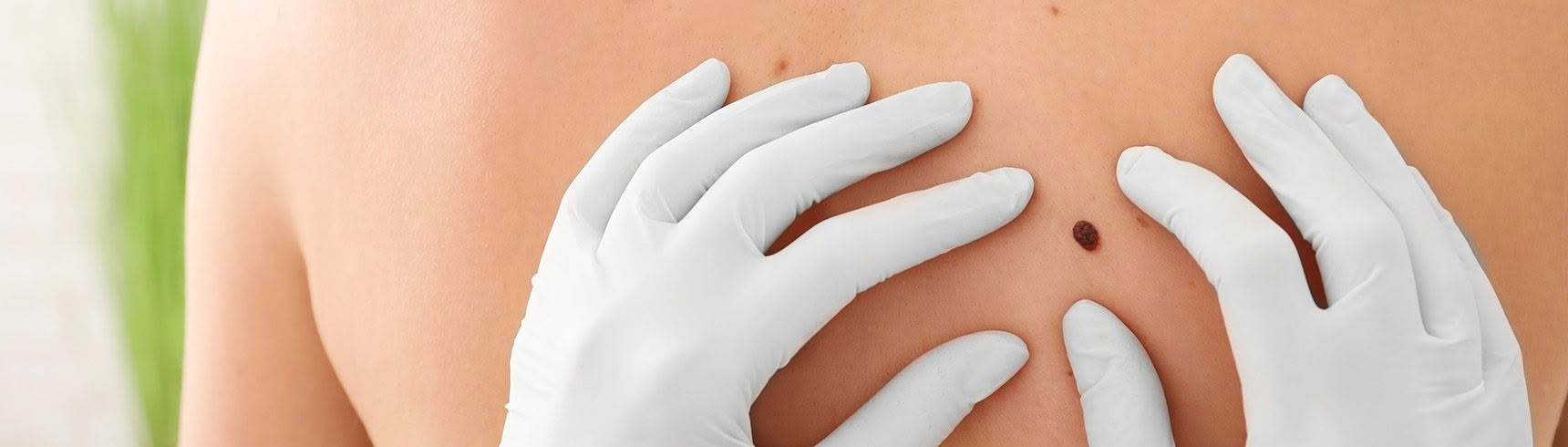
- A careful, head-to-toe look. Including the places that are hard to see and check yourself: the scalp, behind the ears, the back, the backs of the legs, and the soles of the feet. Melanomas can occasionally appear in areas that see very little sun.
- A closer look with a dermatoscope. This is often the most useful part. A dermatoscope is a handheld magnifier with polarised light that allows us to see structures beneath the surface of a spot – pigment patterns and blood vessels – that aren’t visible to the naked eye.
- A clear plan, in plain language. If everything looks benign, we’ll say so and suggest when to come back. If something needs attention, we’ll explain why and talk through the options – which might be simply monitoring it, taking a small sample (a biopsy), or removing it. Nothing is done on the day without a proper conversation first.
No part of a routine check involves cutting. It’s a look, not a procedure.
What we tend to look for
You may have come across the ABCDEs – asymmetry, an irregular border, more than one colour, a diameter over about 6mm, and change over time. They’re a helpful starting point and worth knowing (our separate guide walks through them). In practice, though, we’re looking at a few things alongside that checklist:
- The ‘ugly duckling’. People’s moles usually resemble one another. A spot that clearly looks or behaves differently from its neighbours is worth a closer look, even if it doesn’t tick an obvious box.
- A spot that’s changing. Change is one of the more useful signs. A mole that has grown, darkened, or begun to itch or bleed over recent months is worth attention more than one that has looked the same for years.
- The ones that don’t follow the rules. Some melanomas – nodular ones, for instance – can be firm, single- coloured lumps that don’t fit the ABCDE pattern. A new, firm bump that is growing is worth having checked regardless of how tidy it looks.
- A sore that won’t heal. Not everything is a mole. A patch that scabs, heals and breaks down again, a persistent scaly area, or a pearly bump can be non-melanoma skin cancers, which are more common than melanoma and generally very treatable when found.
GP, skin clinic, or plastic surgeon?
It’s understandable to be unsure where to go. In truth, the best first check is the one you’ll actually book – so if your GP offers skin checks and you’re comfortable there, that’s a perfectly good place to start. Where a specialist practice can add something is at the next step.
Because we’re a plastic surgery practice, our skin cancer service can screen, diagnose and, where needed, treat in the same place, rather than referring you elsewhere for each stage. And if a skin cancer does need removing, it’s done by a surgeon who carries out reconstructive work regularly, with attention to both clear margins and the final scar – which can make a difference, particularly on the face.
Looking after your skin between checks
A professional check is the backbone, but you’re the one who sees your skin day to day. Every month or so, in good light, it’s worth giving yourself an unhurried once-over – and your phone can help. A dated photo of a spot is one of the easiest ways to answer the question that matters most next time: has this changed?
It also helps to ask someone to check your back and scalp, the two areas self-checks tend to miss. The simple guide is this: if a spot is new, changing, or just doesn’t look quite right, it’s worth having looked at rather than waiting.
In short
A skin check is a small and straightforward thing, and most people leave reassured. If there’s a spot you’ve been wondering about, or it’s simply been a while, it’s an easy one to tick off whenever it suits you – and more often than not, you’ll come away with nothing more than peace of mind.
Frequently asked questions
Does a skin check hurt?
No. A routine screening is a visual examination – we look at your skin, including a magnified look at any spots of interest. Nothing is cut or removed during a standard check. If a spot later needs a biopsy or removal, that’s a separate, planned step and the area is fully numbed first.
I’m a little nervous about what they might find. Should I still go?
That’s a very natural feeling, and yes – it’s still worth going. That understandable hesitation is one of the main reasons checks get put off, but the odds are reassuring: the majority of spots turn out to be harmless. And in the less common event that something is found, it’s far better found early, when it tends to be more straightforward to deal with. A check usually replaces a quiet worry with either reassurance or a helpful head start.
How much does a skin check cost, and is treatment covered?
A full-body skin check with Dr Greenbaum – the Skinzure Total Body Skin Check, including dermoscopy and photography as needed – is $449. If something is found that needs treating, that’s a separate, planned step we’ll quote you for clearly. Treatment of a diagnosed skin cancer may also be covered depending on your situation: Adam is an affiliated provider with Southern Cross and registered with most major health insurers.
How often should I be checked?
Annually is a sensible baseline for most adults, and more often if you’re higher risk – fair skin, many moles, a strong sunburn history, or a previous skin cancer. We’ll confirm the right interval for you at your visit.
Do I need a referral from my GP?
No – you don’t need a GP referral. You can book a skin check with us directly; just get in touch with the practice and we’ll find a time that suits. (Of course, if your GP has already spotted something and referred you, that’s welcome too.)